
New Build Snagging Survey: What It Is and What to Do Instead Before You Buy
A new build snagging survey checks a newly completed home for defects before or after you move in. Here’s what it covers, what it typically finds, and what independent survey option makes more sense if you’re buying.

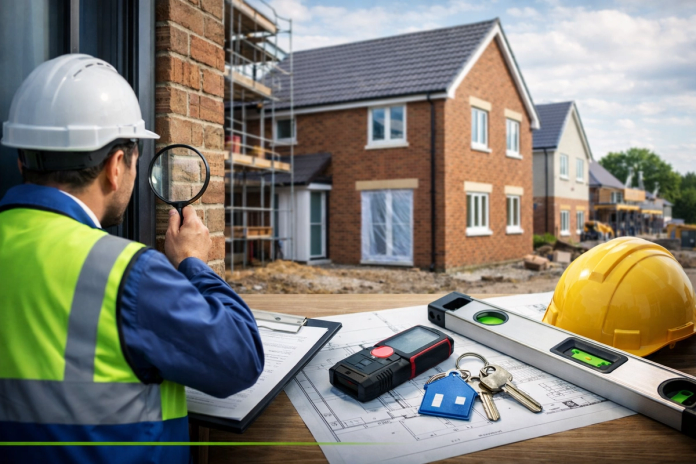
Buying a new build feels like the safe option. Everything is freshly built, under warranty, and unlikely to have the problems you would worry about in an older home. In practice, new builds regularly come with defects. Some cosmetic, some structural, some significant enough to affect how you live in the place or what it is worth.
A snagging survey is the process of finding those defects, typically before legal completion so the developer is obligated to put them right. It has become a standard part of buying new. But it is not the only option, and depending on where you are in the purchase, it may not be the right one.
This guide explains what a snagging survey covers, what defects turn up on new builds, how the NHBC warranty works, and what independent route makes the most sense when you are buying a recently built home.
What is a snagging survey?
A snagging survey is an inspection of a newly built property to identify defects, referred to as "snags", that the developer is responsible for putting right. The term isn't a formal RICS designation. It's an industry term for this kind of post-construction quality check.
Snags range from minor finishing issues, poorly fitted skirting boards, uneven paintwork, gaps around door frames, through to more significant problems such as inadequate insulation, drainage faults, or structural defects that shouldn't be present in a newly completed building. A thorough inspection produces a written snag list that goes to the developer with a request for remediation.
The best time to commission one is before legal completion, while you still have leverage. Once you have completed, the developer has less incentive to act quickly, and some defects become harder to attribute if the property has been lived in.
What does a snagging survey cost?
There is no fixed price. A snagging survey cost typically runs from a couple of hundred pounds up to several hundred, and the figure moves with the size of the property, the number of bedrooms, and where you are in the country. A large detached house takes longer to inspect than a one-bedroom flat, so it costs more.
CJ Bloor works across the North West of England. Rather than a standalone snagging inspection, we provide a RICS Level 2 Home Survey, which covers the same ground and gives you a formal report. You can compare the cost against a snag list in How Much Does a House Survey Cost?.
Who carries out a snagging survey?
There are two routes: the developer's own inspection, or an independent one.
Developers carry out their own pre-completion checks and may invite you to a walkthrough before you move in. That can flag obvious cosmetic issues, but it isn't independent. It's unrealistic to expect a developer to find, or proactively raise, every defect in a property they have a financial interest in selling.
An independent inspection is carried out by a surveyor with no relationship to the developer. That is the only way to get an objective picture. An independent inspector looks at more than the finish: roof structure where accessible, windows and doors, drainage, services, and compliance with building regulations. That is what people mean by a RICS snagging survey. For buyers who want a RICS-qualified assessment rather than a builder's walkthrough, a RICS Level 2 Home Survey is often the better fit, and there is more on that below.
What defects are typically found on new builds?
New builds are not immune to defects. Because they are built quickly and in volume, quality control issues are common. The kinds of problems I see on new build inspections fall into a few groups.
Cosmetic and finishing defects are the most frequent: uneven plaster, inconsistent paintwork, poorly sealed joints, scratched glazing, ill-fitting doors and windows, and missing trim. These are straightforward to put right but can be numerous.
Roof and structure issues include badly installed tiles or slates, inadequate ventilation in roof spaces, poorly fitted loft hatches, and timbers that don't meet specification. These are harder to spot without a proper inspection and can have longer-term consequences.
Services and drainage problems, such as poorly fitted pipework, inadequate falls on drainage runs, boilers not commissioned correctly, or circuits not properly tested, turn up with some regularity. These may not be apparent from a visual walkthrough.
Damp and insulation failures are among the more serious findings. Poorly fitted insulation, missing cavity barriers, or inadequate sealing around openings can lead to heat loss and, over time, condensation or damp penetration.
External works are frequently incomplete at completion: poorly graded driveways, fencing that isn't to standard, or drainage gullies not properly installed.
The Common Defects archive covers many of these in more detail.
The NHBC warranty: what it covers and what it doesn't
Most new build homes in the UK are registered with the National House Building Council (NHBC) and come with a Buildmark warranty. This is a 10-year structural warranty, but it doesn't work the same way for the full decade.
In years one and two, the developer is responsible for putting right any defects that arise from the build not meeting NHBC standards. This is the period when a snag list is most effective. The developer is contractually obligated to respond.
From years three to ten, the warranty covers structural defects only: the load-bearing structure, foundations, or weatherproofing. It does not cover cosmetic defects, appliance failures, or general maintenance.
That distinction matters. Buyers sometimes assume the warranty is a comprehensive guarantee for the first decade. It isn't. Cosmetic and non-structural defects need to be found and resolved in the first two years, which is why an independent inspection before or shortly after completion is so important.
Why a RICS Level 2 survey is often the right choice
CJ Bloor doesn't offer a standalone snagging service, but the RICS Level 2 Home Survey is well suited to buyers of newer or recently built properties and covers much of the same ground, and more.
A Level 2 survey is a RICS-standard inspection carried out by a qualified surveyor. It assesses the condition of the property, assigns condition ratings to each element, and gives clear commentary on any defects found. For newer properties, this gives you an independent, professionally structured report covering the building from roof to ground floor, not just a list of cosmetic snags.
For a newer property with no known complications, a Level 2 is typically appropriate. If there are specific concerns, an unusual construction method, signs of movement, or a property that's been significantly altered, a Level 3 Building Survey provides more detailed investigation.
You can read how the levels compare in the RICS Home Survey Guide, or use the Which Survey Do I Need? tool for a quick steer.
New Build Snagging Survey: Common Defect Categories
Cosmetic & Finishing
Paintwork, plasterwork, skirting boards, door and window fitting, glazing scratches, and incomplete trim. Typically the most numerous category, but straightforward to remediate in year one.
Roof & Structure
Tile and slate installation, roof ventilation, structural timbers, and loft access. Harder to spot without a professional inspection and may have longer-term consequences.
Services & Drainage
Pipework, drainage falls, boiler commissioning, and electrical circuits. Often not visible from a walkthrough.
Damp & Insulation
Poorly installed insulation, missing cavity barriers, and inadequate window sealing can lead to heat loss, condensation, and damp over time.
External Works
Driveways, paths, fencing, and drainage gullies are commonly incomplete or defective at completion.
NHBC Buildmark Warranty
Years 1–2: Developer responsible for all defects against NHBC standards. Years 3–10: Structural defects only. Cosmetic issues are not covered after year two.
What to do if you're buying a new build
The most useful step is to arrange an independent survey before you exchange. This gives you an objective view of the condition, identifies defects the developer needs to address, and documents the state of the property at the point of purchase.
Even on a brand-new home, don't rely solely on the developer's own checks or the NHBC process. Both serve a purpose, but neither is a substitute for an independent RICS-qualified assessment on your behalf.
If you've already completed and moved in, you're still within your rights to raise defects in the first two years. Keep a written record with photographs and dates. Use the Repair Cost Estimator to get a rough sense of what any outstanding defects might cost if the developer is slow to act.
Frequently asked questions
What is a snagging survey?
A snagging survey is an inspection of a newly completed property to identify defects, known as snags, that the developer is responsible for putting right. These range from cosmetic finishing issues to more significant problems with the structure, services, or drainage. The ideal time to commission one is before legal completion, while you still have leverage. If you have already completed, you can still raise defects formally in the first two years under the NHBC Buildmark warranty.
Is a snagging survey worth it?
For most buyers, yes. New builds are put up quickly and in volume, and defects are common. An independent inspection gives you a documented list the developer is more likely to act on, and it records the state of the property at purchase. That said, a formal RICS Level 2 Home Survey covers the same condition ground and gives you a structured, professionally recognised report. For many buyers that is the more useful document.
Should I get a snagging survey on a new build?
I'd suggest an independent assessment on any new build before you exchange, whether that is a snagging survey or a RICS survey. Don't rely solely on the developer's walkthrough or the NHBC inspection, as neither is carried out on your behalf. If you have specific concerns or the property has changed hands quickly, a Level 3 Building Survey may be more appropriate than a standard snag list.
How much is a snagging survey?
There is no fixed price. A snagging survey cost typically runs from a couple of hundred pounds up to several hundred, depending on the size of the property and where you are in the country. A large detached house costs more to inspect than a small flat. For a like-for-like comparison against a RICS survey, see How Much Does a House Survey Cost?.
Book a Level 2 Survey for Your New Build
A RICS Level 2 Home Survey gives you an independent assessment of your new build's condition before you commit, carried out by a RICS-qualified surveyor with no connection to the developer. Get a quote online in minutes.
More on rics home surveys
RICS Condition Ratings Explained
Your RICS survey report gives every element a Condition Rating of 1, 2, 3 or NI. Here’s what each one means and what to do when you see it.
Read →The Process of Selling a House in the UK: A Step-by-Step Guide
Selling a house in England or Wales involves a number of different steps, from preparing the property for the market through to exchanging contracts and completing the sale.
Read →Do You Need a Valuation with Your Survey?
Do You Need a Valuation with Your Survey? When booking a home survey, it’s natural to wonder whether you should also request a valuation.
Read →Need a survey on a specific property?
Tell us the address and we will send a fixed price in writing, with no obligation.
Get your fixed quote →