
Level 2 vs Level 3 Survey: Which Do You Need?
Not sure whether you need a Level 2 or Level 3 survey? We explain the difference and help you choose the right survey for your property.

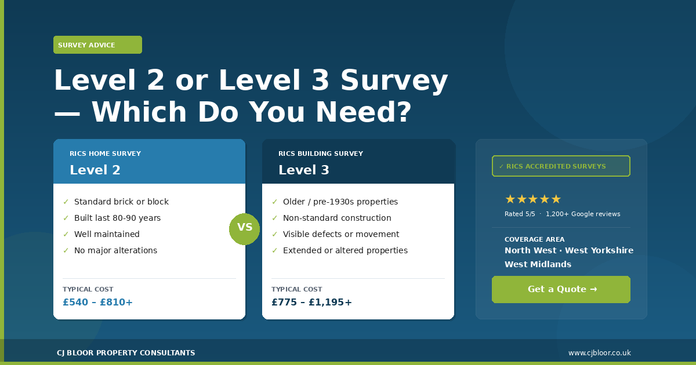
Level 2 or Level 3 Survey — Which Do You Need?
The right survey depends on your property's age, condition and complexity. This guide cuts through the confusion — so you can book with confidence.
Chris Bloor MRICS
·
CJ Bloor Property Consultants
·
✓ RICS Accredited
Surveys covered
Level 2 & Level 3
Regulated by
RICS
Coverage area
North West · West Yorkshire · West Midlands
Google rating
★★★★★ 1,200+ reviews
Not sure which level you need? Try our free
— answer 8 quick questions and we'll tell you which level is right for your property.
Choosing the right survey is one of the most practical decisions you'll make when buying a property. Get it right and you'll have a clear picture of what you're buying. Get it wrong and you could end up with a report that doesn't give you enough detail — or pay for more than you needed.
This guide explains what separates the Level 2 and Level 3 surveys and helps you work out which one is right for your property.
1
What Are the RICS Survey Levels?
RICS Home Surveys are categorised into three levels. Each covers progressively more ground, and the right choice depends on your property's age, condition and complexity.
Level 1 (Condition Report) is the most basic option — a broad overview for newer properties in good condition, without advice on repairs. CJ Bloor don't carry out Level 1 surveys. In our experience, most buyers need at least a Level 2 to make a properly informed decision.
The choice most homebuyers are making is between Level 2 and Level 3.
🏠
RICS Home Survey
Level 2
A thorough visual inspection of all accessible parts of the property, with condition ratings and advice on repairs and maintenance.
- Standard brick or block construction
- Built within the last 80–90 years
- Reasonably well maintained
- No significant alterations
🏛️
RICS Building Survey
Level 3
The most detailed assessment available. Goes deeper on defect causes, hidden problems and long-term maintenance implications.
- Older or pre-1930s properties
- Non-standard construction
- Visible defects or structural concerns
- Extended, altered or complex properties
2
What Does a Level 2 Survey Cover?
The Level 2 survey — formerly called the HomeBuyer Report — is the most common choice for buyers purchasing a standard residential property. It involves a thorough visual inspection of all accessible parts of the building, inside and out.
Every element is rated using a traffic light condition system:
Condition Ratings
CR 1
No repair needed — maintain in the normal way.
CR 2
Defects that need attention, but are not urgent or serious.
CR 3
Defects that are serious or require urgent attention.
The report covers the roof, walls, floors, windows, doors, services and outbuildings. It includes advice on repairs and maintenance, and flags anything that may need further investigation by a specialist.
Think a Level 2 is right for your property?
Get a personalised quote — every enquiry is reviewed individually by our team.
3
What Does a Level 3 Survey Cover?
The Level 3 Building Survey is the most detailed assessment available. It goes further than the Level 2 in both the depth of inspection and the content of the report.
Where a Level 2 survey identifies defects and rates them, a Level 3 examines why defects have occurred, considers the potential for hidden problems, and provides detailed advice on remediation and long-term maintenance. The surveyor will enter the roof space, lift loose floor coverings where possible, and inspect drainage inspection chambers where safe to do so.
Always choose Level 3 when:
- The property was built before 1919
- It has non-standard construction — stone, timber frame, concrete, listed, prefab
- There are visible cracks, damp or signs of structural movement
- The property has been significantly extended or altered
- You are planning major renovation or structural works
- The purchase price is high and you want maximum detail before committing
When in doubt, a Level 3 is rarely the wrong call. The additional cost is modest relative to the purchase price — and the extra detail it provides can be invaluable, both for peace of mind and for any post-survey negotiations.
4
Level 2 vs Level 3 — Side by Side
| Feature | Level 2 | Level 3 |
|---|---|---|
| Condition ratings (traffic light) | ✓ | ✓ |
| Advice on repairs & maintenance | ✓ | ✓ |
| Roof space inspection | From hatch only | Full entry where accessible |
| Floor inspection | Exposed floors | Lifts loose coverings where possible |
| Drainage inspection chambers | Lifted where safe | Lifted, drainage operation observed |
| Depth of defect analysis | Identified & rated | Identified, analysed, prognosis given |
| Repair & maintenance guidance | Standard | Detailed — long-term implications included |
| Best suited to | Standard properties, post-1930s | Older, altered or complex properties |
| Still unsure? Try our free survey selector tool or request a quote and we'll advise you directly. |
5
Common Questions
Frequently asked questions
Not always. For a well-maintained post-war property of standard construction, a Level 2 typically gives you everything you need. A Level 3 adds real value when the property is older, has been significantly altered, or where there are visible signs of defects you want investigated in depth.
Yes — provided the survey hasn't yet taken place, contact us and we can adjust your booking. If you're unsure before you book, just ask. Every enquiry is reviewed individually and we're happy to advise before you commit.
No. In our experience, most buyers need at least a Level 2 to make a properly informed decision. We focus entirely on Level 2 and Level 3 surveys, carried out to a consistently high standard.
Costs vary by property value, size and location. See our full price breakdown in the
, or
directly.
Yes. A
can be added to either survey level — carried out at the same visit. Particularly useful for cash buyers or anyone who wants an independent view of market value alongside the condition report.
A Level 2 survey typically takes 1–3 hours on site, depending on the size of the property. A Level 3 usually takes 2–5 hours. The report is prepared after the inspection and delivered separately.
CJ Bloor Property Consultants
★★★★★
Rated 5/5 from over 1,200 Google reviews
Ready to book your survey?
RICS-accredited surveyors covering the North West, West Yorkshire and West Midlands. Get a personalised quote in minutes.
Call
·
·
More on rics home surveys
Is My Surveyor Qualified?
There are lots of questions that come up when you’re investing in a property.
Read →What is ‘gazumping’ and how to avoid it?
Buying a home can be quite a tricky process, with lots of things to consider.
Read →Is Your Home Prone to Flooding? What Surveyors Look for
Table of Contents According to recent studies, as many as 1 in 6 properties in the UK are at risk of flooding. This is even more true if you live in one of the UK’s flooding hotspots (admittedly you could argue that’s the whole of the UK).
Read →Need a survey on a specific property?
Tell us the address and we will send a fixed price in writing, with no obligation.
Get your fixed quote →