
Understanding Different Types of House Surveys
A plain guide to the house survey types in the UK: what Level 1, 2 and 3 cover, and how to choose the right one for the property you are buying.

When buying a property, a clear understanding of its condition matters. This is where house surveys come in. A survey gives you an independent view of structural issues, defects and areas likely to need maintenance, so you can make a decision with the facts in front of you.
There are several house survey types in the UK, and choosing the right one saves time and money. This guide explains the different types of house survey, what each includes, and when each is most appropriate.
The main house survey types at a glance
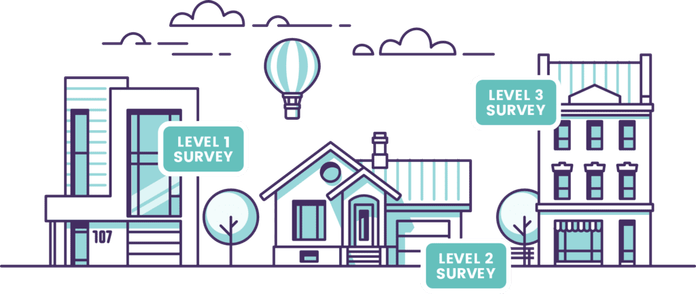
Most buyers are choosing between three RICS survey levels:
- Level 1 (Condition Report): a basic overview for newer homes in good order.
- Level 2 (HomeBuyer Report): a more detailed assessment for conventional properties in reasonable condition.
- Level 3 (Building Survey): the most thorough option for older, larger or altered homes.
A RICS valuation sits alongside these but answers a different question: what the property is worth, not what condition it is in.
The right choice depends on the property, not on your budget alone. Age, construction type, size and any past alterations all point towards a level.
RICS Condition Report (Level 1)
The RICS Condition Report is the most basic type of property survey offered by the Royal Institution of Chartered Surveyors (RICS). It’s ideal for newer properties or homes in good condition. This survey provides an overview of the property’s condition, highlighting any significant defects and potential risks. However, it does not include a valuation or detailed advice on repairs.
The RICS Condition Report is a general overview of a property’s health. It uses a clear ‘traffic light’ system to rate the condition of different parts of the building:
- Green: No repair needed.
- Amber: Some attention required.
- Red: Serious defects or issues that need immediate attention.
This survey is primarily for informational purposes and will not delve into minor or cosmetic issues. It’s also the quickest and most cost-effective option, making it suitable for buyers with a tight budget or looking at properties less than ten years old. For this reason, many firms, including CJ Bloor, do not offer this level of survey.
For a more detailed assessment, a higher-level survey is usually required, particularly if the property is older or has undergone extensive renovations. You can read more about the RICS condition ratings explained and how they carry through to the higher levels.
RICS HomeBuyer Report (Level 2)
The RICS HomeBuyer Report, also known as a Level 2 survey, is one of the most popular choices for buyers. It is suitable for conventional properties in reasonable condition and typically includes a more in-depth evaluation than the Condition Report.
This survey provides:
- A more detailed assessment of the property’s condition, identifying structural issues and visible defects.
- Advice on necessary repairs and ongoing maintenance.
- A market valuation and reinstatement cost (for insurance purposes) – available as an “Add-on service”.
The HomeBuyer Report also uses the traffic light system but includes a more thorough analysis of each area, helping prospective buyers understand any defects and potential future expenses. This type of survey is ideal for properties built within the last 50-75 years that haven’t been significantly altered or expanded.
If you’re considering a HomeBuyer Report, CJ Bloor Property Consultants can provide professional services tailored to your specific needs. To find out more, visit RICS Level 2 HomeBuyer Report.
RICS Building Survey (Level 3)
The RICS Building Survey, also known as a Level 3 survey, is the most comprehensive type of property survey. This survey is suitable for larger, older, or significantly altered properties. It is especially recommended for buildings constructed before 1900, listed properties, or homes that have undergone extensive renovations.
The Building Survey includes:
- A detailed analysis of the property’s structure and condition.
- An extensive report on defects, their potential implications, and recommended repairs.
- Information on the property’s construction materials and any potential issues related to them.
- Technical advice on necessary repairs and maintenance schedules.
Unlike the HomeBuyer Report, the Building Survey does not include a dedicated section for a valuation. However, it offers a more granular view of the property’s health, often spanning over 30 pages or more, with photographs and illustrations to support findings. This type of survey is ideal for those looking to undertake major renovation works or who want to ensure that no aspect of the property’s condition is left unexplored.
For more guidance on a Level 3 survey, visit RICS Level 3 Building Survey.
RICS Valuation
While not a traditional survey, a RICS Valuation can be carried out alongside a survey or independently. A RICS Valuation is often requested by mortgage lenders to ensure that the property is worth the agreed purchase price. It’s also used for purposes such as probate, tax calculations, or shared ownership buy-outs.
RICS Valuations are carried out by a qualified RICS surveyor and provide an unbiased market value assessment, which can be invaluable in negotiations. Unlike surveys, a RICS Valuation does not include an in-depth assessment of the property’s condition but focuses solely on its value.
It is worth being clear on the difference here, because buyers often confuse the two. Our guide to survey vs mortgage valuation sets out what each one is for.
For more information on RICS Valuations, consider exploring RICS Valuations Services offered by CJ Bloor Property Consultants.
Specialist Surveys
In addition to the standard surveys, there are various specialist surveys available for particular concerns:
- Damp Survey: Assesses moisture levels, potential sources of dampness, and suggests remediation measures.
- Timber Survey: Focuses on the condition of woodwork, detecting signs of infestation, decay, or structural weakness.
- Roof Survey: Evaluates the condition of the roof, checking for leaks, insulation issues, or damage that might lead to further complications.
These specialised surveys are often recommended if the standard surveys indicate particular areas of concern or if the property has known issues, such as historic damp problems or timber defects. In most cases a Level 2 or Level 3 survey comes first, and a specialist is only brought in where the surveyor flags something that needs an intrusive or specialist inspection.
How to choose between the house survey types
There is no single right answer, but a few questions usually settle it.
Consider the age of the property
Older homes were built with different materials and methods, and they have had more time to develop faults. A property built before 1900, or one that has been extended and altered over the years, tends to need a Level 3 survey. A modern home in good order may only need a Level 2, or in some cases a Level 1.
Consider the condition and any alterations
If the property has obvious problems, a history of damp, or work that looks like it was done without the right consents, the extra detail of a Level 3 is likely to pay for itself. A conventional house in reasonable condition is usually well served by a Level 2.
Consider what you plan to do
If you intend to renovate, knock through or take on a project, a Level 3 gives you the structural detail you need before you commit. If you simply want a sound home to move into, a Level 2 answers most of the questions that matter.
If you are still weighing it up, the Homebuyer Report vs Building Survey guide walks through the same decision in more depth.
Frequently asked questions
What are the main types of house survey in the UK?
The main types are the RICS Level 1 Condition Report, the RICS Level 2 HomeBuyer Report and the RICS Level 3 Building Survey. Each covers more detail than the last. A RICS valuation is separate and deals with worth rather than condition.
Which type of house survey do I need?
It depends on the property. A modern home in good condition usually needs a Level 2. An older, larger or altered property, or one you plan to renovate, is likely to need a Level 3. Level 1 suits newer homes in good order where you only want a general overview.
Is a mortgage valuation the same as a survey?
No. A mortgage valuation is carried out for the lender to confirm the property is worth what you are paying. It is not a survey of condition and it is not written for you. A survey is a separate report on the state of the property and any defects it appears to have.
Do I always need a specialist survey?
Usually not. Specialist surveys for damp, timber or the roof are normally arranged only when a Level 2 or Level 3 survey flags a concern that needs a closer, more intrusive look. In most purchases a standard RICS survey covers what you need.
Does a Level 3 survey include a valuation?
No. A Level 3 Building Survey focuses on condition and does not include a dedicated valuation. If you need a figure for the property's worth, that is a separate RICS valuation, which can be arranged alongside the survey.
More on rics home surveys
How to Choose the Right Firm for Your Home Survey
Selecting the right firm for your home survey is important to ensure you receive a detailed, high-quality report that gives you complete confidence in your property purchase.
Read →Level 2 vs Level 3 Survey: Which Do You Need?
Not sure whether you need a Level 2 or Level 3 survey? We explain the difference and help you choose the right survey for your property.
Read →Is My Surveyor Qualified?
How to tell if your surveyor is qualified: check the RICS chartered surveyor register, understand the qualifications and spot the red flags.
Read →Need a survey on a specific property?
Tell us the address and we will send a fixed price in writing, with no obligation.
Get your fixed quote →