
Survey vs Mortgage Valuation: What's the Difference?
A mortgage valuation and a property survey are not the same thing. Here's what each covers, who it protects, and what buyers need to know before committing.

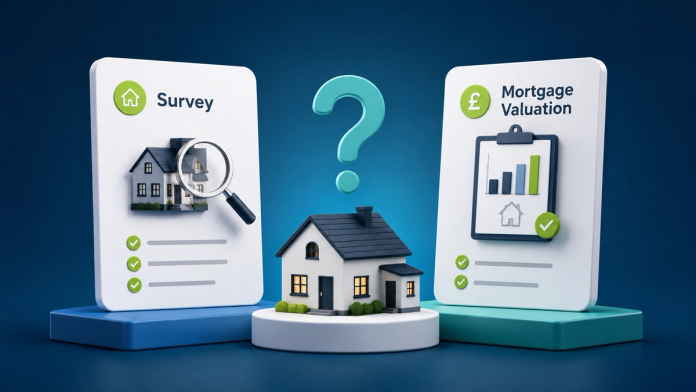
When you apply for a mortgage, your lender will arrange a valuation of the property. Many buyers assume this means the property has been checked over and given a clean bill of health. It hasn't. So what is a mortgage survey, and why does it protect the lender rather than you?
The mortgage valuation, sometimes called a mortgage survey, is carried out for the lender's benefit, not yours. It tells you almost nothing about the condition of the building you're about to buy.
A property survey is an entirely separate instruction, commissioned by you, and designed to give you an independent assessment of what you're purchasing. The two are often confused, but they serve different purposes, answer different questions, and carry very different levels of risk if you rely on one when you should be using the other.
This post explains what each report actually covers, how they differ in scope and purpose, and what you need to know before making decisions about either.
What is a mortgage survey?
A mortgage survey, properly called a mortgage valuation, is a brief assessment carried out on behalf of your mortgage lender to confirm that the property is worth broadly what you've agreed to pay for it. The lender needs this before they'll advance funds: if you were to default on the mortgage, they need confidence the property could be sold to recover what's owed.
The inspection itself is typically short. The valuer, instructed directly by the lender, will visit the property, note its general condition, check it against comparable local sales data, and confirm a figure. In some cases, particularly for newer properties in good condition, lenders may carry out a desktop or automated valuation without any physical visit at all.
Crucially, a mortgage valuation is not a survey. It doesn't assess the structural condition of the property in any meaningful detail, it doesn't identify defects, and it doesn't tell you whether there are problems you should know about before you buy. The report belongs to the lender, and while you may receive a copy, it is produced to protect their interest, not yours.
What is a mortgage valuation survey?
The terms get used loosely. "Mortgage survey", "mortgage valuation survey" and "mortgage valuation" all describe the same thing: the short check a lender arranges to confirm the property secures the loan. The word "survey" in that phrase is misleading, because it implies a condition inspection that simply is not taking place.
If you want a proper assessment of the building's condition, that is a RICS survey, and you commission it separately. For more on where the two part ways, see Survey vs Mortgage Valuation: What's the Difference? and Do I Need a Valuation Survey or a Home Survey?.
What is a property survey?
A property survey is an independent inspection commissioned by you, carried out by a RICS surveyor, to assess the condition of the property you're buying. Unlike a mortgage valuation, a survey is carried out entirely in your interest. The surveyor's professional duty runs to you as the client, not to a lender or any other party.
RICS surveys come in two main levels for residential purchases. A Level 2 Home Survey is a condition-rated inspection suited to conventional properties in reasonable condition: it covers all accessible parts of the building, assigns condition ratings to each element, and flags anything that needs attention. A Level 3 Building Survey is a more detailed technical inspection recommended for older properties, larger homes, non-standard construction, or anywhere defects are suspected. The RICS Home Survey Guide explains the differences in full.
A survey gives you documented, professional evidence of the property's condition at the point of purchase. That evidence can inform your decision to proceed, support a renegotiation of the price, or, in serious cases, give you grounds to walk away.
The key differences
The most important distinction is purpose. A mortgage valuation answers one question: is this property worth enough to secure the loan? A survey answers a different and far more relevant question for the buyer: what condition is this property in, and what do I need to know before I commit?
The scope of inspection reflects that difference. A mortgage valuation is typically a brief visit focused on market value. A RICS survey is a systematic inspection of the building's fabric: roof, walls, floors, windows, doors, services, drainage, with condition ratings and professional commentary on every element.
The other critical difference is who the report is for. The mortgage valuation is the lender's document. Even if you're given a copy, it carries no professional duty to you as a buyer, and you cannot rely on it in the way you can rely on a survey commissioned in your name.
Can a mortgage valuation be used to renegotiate the price?
In one limited scenario, yes. If the lender's valuation comes in below the agreed sale price, known as a down valuation, that creates a funding gap, because the lender will only advance a percentage of the lower figure. That gap can give you grounds to renegotiate, and some buyers do successfully use down valuations to reduce the agreed price.
However, a mortgage valuation cannot be used to flag defects or condition issues, because it doesn't assess them. If you want to renegotiate on the basis of what's wrong with the property, you need a survey, and a surveyor's written report identifying specific defects is a far stronger basis for that conversation.
Do I still need a survey if the mortgage valuation comes back fine?
Yes, and this is one of the most common misunderstandings in the home buying process. A mortgage valuation confirming the agreed price is broadly correct tells you nothing about the condition of the building. A satisfactory valuation simply means the lender is willing to lend. It is not a structural assessment, and it is not a substitute for independent professional advice on the property's condition.
Defects that would be identified in a survey, such as roof deterioration, damp, structural movement, drainage problems or inadequate insulation, may be present in a property that passes a mortgage valuation without any issue. The two assessments are not comparable in scope, and one does not replace the other. The Risks of Buying a House Without a Survey sets out what is at stake if you rely on the valuation alone.
Survey vs mortgage valuation, at a glance
Mortgage valuation
Commissioned by your lender. Confirms the property is worth broadly what you've agreed to pay. Brief inspection, or no physical visit at all. Does not assess condition, identify defects, or protect the buyer.
RICS property survey
Commissioned by you. Assesses the condition of the building in full. Identifies defects, assigns condition ratings, and provides professional advice entirely in your interest as the buyer.
Who does it protect?
The mortgage valuation protects the lender. Even if you receive a copy, it carries no professional duty to you. Only a survey commissioned in your name gives you that protection.
Down valuation
If the lender values the property below the agreed price, a funding gap arises. This can be used to renegotiate on price, but not on condition. Defect-based renegotiation requires a survey.
Level 2 Home Survey
Condition-rated inspection for conventional properties in reasonable condition. Covers all accessible elements of the building with clear ratings and recommendations.
Level 3 Building Survey
Detailed technical inspection for older, larger, or non-standard properties. Recommended where defects are suspected or the property has been significantly altered.
Which do you need, and when?
In most residential purchases involving a mortgage, you'll encounter both. The lender arranges the valuation as part of their own process; you arrange the survey separately, in your own name, at your own instruction. The two run in parallel and serve entirely different purposes: getting one does not mean you don't need the other.
The right time to instruct a survey is after your offer has been accepted and the purchase is progressing. Most buyers do so once a mortgage offer is in place, though there is nothing stopping you commissioning one earlier if you want independent information about the property's condition before committing further.
For most conventional properties, a Level 2 Home Survey is the appropriate choice. For older properties, those of non-standard construction, or anywhere you have specific concerns, a Level 3 Building Survey provides the more detailed investigation. If you're unsure which applies to your property, the free Which Survey Do I Need? tool takes under a minute and will point you in the right direction.
Frequently asked questions
What is a mortgage valuation survey?
A mortgage valuation survey is the short check a lender arranges to confirm the property is worth broadly what you have agreed to pay. It secures the loan, not your interests. It is not a condition inspection: it does not identify defects or tell you whether the building is sound. For that you need a RICS survey commissioned in your own name.
Do I still need a survey if the mortgage valuation comes back fine?
Yes. A mortgage valuation confirming the agreed price is broadly correct tells you nothing about the condition of the building. A satisfactory valuation simply means the lender is willing to lend. It is not an assessment of the property's structure, fabric or state of repair, so a survey is always recommended regardless of the valuation outcome.
Can I use the mortgage valuation report to renegotiate the price?
Only in a limited sense. If the lender's valuation comes in below the agreed sale price, a down valuation, that can be grounds to renegotiate, as the lender will only advance a percentage of the lower figure. You cannot use the mortgage valuation to flag defects, as it does not assess condition. That is what a survey is for.
Is a survey a legal requirement when buying a property?
No. A survey is not a legal requirement in England and Wales. The principle of caveat emptor, buyer beware, applies to property purchases, meaning the buyer carries the responsibility for satisfying themselves about the condition of what they are buying. A survey is the primary means of doing so.
When should I book a survey, before or after my mortgage offer?
In most cases buyers instruct a survey after the mortgage offer has been issued, once the purchase is progressing. There is no reason you cannot instruct one earlier, particularly if you have concerns about the property's condition and want information before committing further. The survey can take place at any point after your offer is accepted.
A mortgage valuation tells your lender what they need to know. A RICS survey tells you. Get a quote for a Level 2 or Level 3 survey and go into your purchase with a clear picture of what you're buying.
More on rics home surveys
New Build Snagging Survey: What It Is and What to Do Instead Before You Buy
A new build snagging survey checks a newly completed home for defects before or after you move in. Here’s what it covers, what it typically finds, and what independent survey option makes more sense if you’re buying.
Read →RICS Condition Ratings Explained
Your RICS survey report gives every element a Condition Rating of 1, 2, 3 or NI. Here’s what each one means and what to do when you see it.
Read →The Process of Selling a House in the UK: A Step-by-Step Guide
Selling a house in England or Wales involves a number of different steps, from preparing the property for the market through to exchanging contracts and completing the sale.
Read →Need a survey on a specific property?
Tell us the address and we will send a fixed price in writing, with no obligation.
Get your fixed quote →