
Catnic Lintel Problems: Corrosion, Bearing and Cracking
What a Catnic lintel is, where it sits above doors and windows, and the problems a surveyor finds: corrosion, poor bearing, thermal bridging and cracking.

What a Catnic lintel is and where it sits
A Catnic lintel is a pressed steel beam that carries the weight of the wall above a door or window opening. Catnic is a long-established manufacturer, and the name is now used loosely for steel lintels of this type, in the same way people say Hoover for a vacuum.
The lintel is shaped in profile so it supports both the outer and inner leaf of a cavity wall. In a cavity wall it is the inner leaf that carries most of the load, so the lintel is designed to take that weight and pass it down safely at each end. The sloping top face of the lintel usually acts as a cavity tray, catching any water running down the cavity and sending it back out to the face of the wall. It spans the opening and bears onto the brickwork or blockwork at each end. In most homes you never see it: it is plastered over inside and hidden behind the top course of brick or the render outside. The back and underside are often perforated so plaster grips the steel.
Catnic lintels became common from the 1970s onwards. Before that, openings were often spanned by concrete lintels, timber bressummers or brick arches. Many concrete lintels from the 1940s and 1950s had no cavity tray, so damp crossing to the inside was a common problem, and the box steel lintel was a real improvement: lighter, carried by one person, and with the tray built in. If you want the detail on the older type, we cover it in Concrete Lintel Failure: Signs, Repairs and Replacements.
The steel does a simple job. When it works, it carries the load quietly for the life of the building. When it fails, the brickwork above it starts to move, and that is what a surveyor is looking for.
Chris Bloor, on siteThe tell with a rusting Catnic is usually above your head, not in front of you. Look along the mortar bed a course or two over the window. If that line has lifted or opened up level, and the bricks look tight at the corners, the steel underneath is often swelling as it rusts. I've seen it more than once where the weep holes had been mortared over, so water sat on the lintel with nowhere to go. Run a finger along the head outside and check those little gaps are clear. A blocked one tells you more than the crack does.
The common problems a surveyor finds
Corrosion
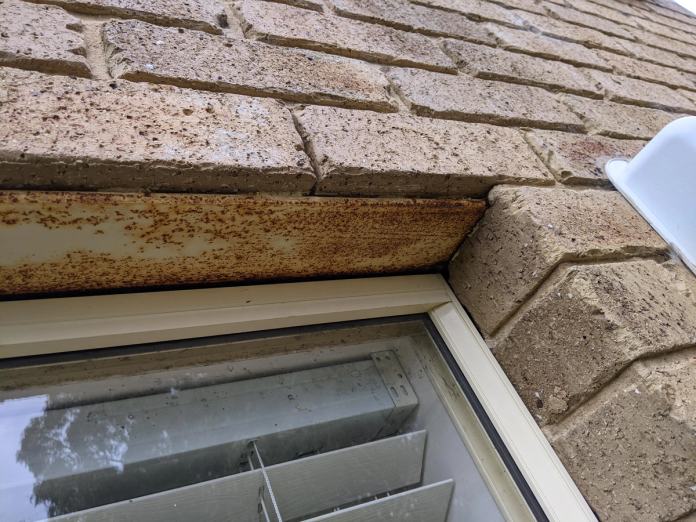
Steel lintels are galvanised to resist rust, but the protection does not last forever. Where water gets into the cavity and sits on the lintel, the galvanising breaks down and the steel corrodes.
Rust occupies more volume than the steel it replaces. As it builds up, it can lift the brick courses resting on the lintel. On older galvanised lintels, particularly those installed before protective coatings improved, this is the fault we see most often.
The outer face of the lintel is usually the first to go, because that is where driving rain and cavity moisture collect. Blocked or missing cavity trays and weep holes make it worse by trapping water on the steel. Weep holes should sit on the cavity tray just over the lintel, and there should be one or more on each side of the opening, so water has a clear path out. Where they are mortared over or were never formed, water has nowhere to go but onto the steel.
Inadequate bearing
A lintel needs a minimum length of solid wall at each end to carry the load down safely. This is the bearing, and on a typical lintel it is around 150mm at each end. Where the lintel was cut short, or the opening was later widened without the bearing being checked, the ends can be overloaded.
Poor bearing shows up as cracking or crushing at the corners of the opening, or a slight sag in the lintel line. It is a particular risk where someone has altered the openings in a conversion or extension without proper structural advice.
Thermal bridging
Steel conducts heat well, which is a problem in a wall. The lintel can form a cold bridge across the cavity, letting warmth escape and drawing condensation to the inner face. The risk is greater in modern, well-insulated walls, where a cold strip behind the frame stands out against the warm wall around it.
The usual sign inside is a line of damp, mould or staining on the ceiling or wall directly above the window reveal. On an early lintel with no thermal break, this can be a persistent nuisance rather than a structural fault. Many modern lintels are made with insulation built in to reduce this.
Cracking to the brickwork above
All of the faults above tend to announce themselves the same way: cracks in the masonry over the opening. Horizontal cracking along a mortar bed can point to a rusting lintel pushing the brick upward. Stepped cracking running diagonally from the corners can point to a bearing or movement problem.
Because of the way brickwork bonds together, only a small triangle of masonry directly over an opening actually bears on the lintel, so the load it carries is usually modest. That is why a sound lintel can sit quietly for decades, and why a fault that does show tends to be worth taking seriously.
Not every crack over a window is a lintel fault. Settlement, subsidence and thermal movement all leave marks in the same area, which is why a surveyor reads the whole wall rather than the one crack. Our guide to Settlement of Houses: Cracks or Subsidence? sets out how we tell them apart.
How these issues are identified in a survey
The steel lintel itself is hidden, so a surveyor works from the evidence around the opening. On both a Level 2 and a Level 3 survey, we inspect each window and door head inside and out for the signs above: cracking, displaced brickwork, sagging, damp staining and corrosion where any edge of the lintel is visible.
The difference between the two levels is depth, not whether the lintel is checked.
| Point | Level 2 | Level 3 |
|---|---|---|
| Lintels inspected | Yes, each opening | Yes, in more detail |
| Condition rating | Given per element | Given per element |
| Cause of cracking | Noted and flagged | Analysed more fully |
| Repair guidance | General | Specific next steps |
| Best for | Modern, sound homes | Older or altered homes |
On a Level 2 survey we give each element a condition rating and flag anything that needs attention. On a Level 3 survey we go further into why the defect has happened and what order the work should follow, which suits older houses and anywhere the openings have been altered.
One detail worth knowing: disturbed or rebuilt brickwork of two or three courses directly over a window, often on a 1960s or 1970s house, is frequently a sign of a past repair to a failed or missing cavity tray. We look for that pattern as well as fresh cracking.
If you are weighing up which level fits your property, the tool below gives a straight recommendation.
We cannot open up the wall on a standard survey, so where we suspect corrosion behind the masonry we say so and recommend further investigation rather than guess at the steel's condition. That is the honest position: the signs are visible, the steel is not.
Chris Bloor, on siteThe thing a survey cannot do is open the wall up, so there's a limit to how far we can go on the day. Where the signs point to rust behind the brick but the steel is buried, we say that plainly and send it on to an engineer. No point guessing at metal nobody can see. What helps is the age and the openings: a 1970s house with two courses of neater brick over one window, and the same window widened at some point, tells us where to press harder. We read the whole elevation, not the one crack that caught your eye.
What remedial action may be advised
The right repair depends on the fault, so the first step is usually a closer look by a structural engineer where the survey raises a concern.
- Minor corrosion with no movement: keep the cavity clear, clear the weep holes and monitor. Often no structural work is needed.
- Rusting lintel lifting the brickwork: the brickwork above is taken down, the lintel is replaced with a modern galvanised or stainless steel unit, and the masonry is rebuilt.
- Inadequate bearing: the opening may need a longer or stronger lintel, or the bearing rebuilt in solid masonry. This is engineer-led.
- Thermal bridging and condensation: improving ventilation and, where the lintel is being replaced anyway, fitting a unit with a thermal break.
- Cracking from another cause: if the lintel is sound and the cracking is settlement or movement, the repair follows the real cause, not the lintel.
Replacing a lintel is disruptive but well understood. The cost depends on the span, access and how much brickwork has to come down. We would not put a single figure on it without seeing the opening, as the range is wide.
If your report has already raised a lintel concern, our guide on how to renegotiate an offer after a home survey explains how buyers use that evidence.
Frequently asked questions
How do I know if my house has a Catnic lintel?
Most cavity-walled homes built from the 1970s onward use a steel lintel of this type over windows and doors. You usually cannot see it, as it is plastered over inside and hidden behind brick or render outside. A survey will note the likely lintel type from the age and construction of the property.
Is a cracked lintel a serious problem?
It can be. Cracking over an opening may mean the lintel is corroding and pushing the brickwork, or that its bearing is overloaded. It may also be unrelated movement. We recommend having it looked at rather than left, because the cost of repair tends to rise the longer it is ignored.
Will a Level 2 survey pick up a lintel fault?
Yes. A Level 2 survey inspects each window and door head and gives a condition rating, so visible signs of a lintel problem are flagged. A Level 3 survey goes further into the cause and the repair sequence, which suits older or altered properties.
Can a corroded lintel be repaired without replacing it?
Sometimes. Where corrosion is light and there is no movement, keeping the cavity and weep holes clear and monitoring may be enough. Where rust has already lifted the brickwork or the steel is badly degraded, replacement is usually the sound long-term fix.
More on common defects
Concrete Lintel Failure: Signs, Repairs and Replacements
What a concrete lintel does, the failure signs a surveyor flags, and practical notes on sizing, bearing and sourcing replacements.
ReadHow Deep Are Foundations for a House? A Surveyor's Guide
Domestic foundations are often around 0.9m to 1.5m deep, but the right depth depends on soil, trees and ground conditions. Here is what drives it.
ReadDamp Proof Course: Types, Costs and Regulations
What a damp proof course is, the main types including injected systems, realistic costs and the regulations that apply.
ReadNeed a survey on a specific property?
Tell us the address and we will send a fixed price in writing, with no obligation.
Get your fixed quote