
Cavity Wall Tie Failure
Cavity wall tie failure is concealed, gradual and common in a band of 1920s to 1970s housing. Here is how a surveyor spots it, how it is confirmed and what repair involves.

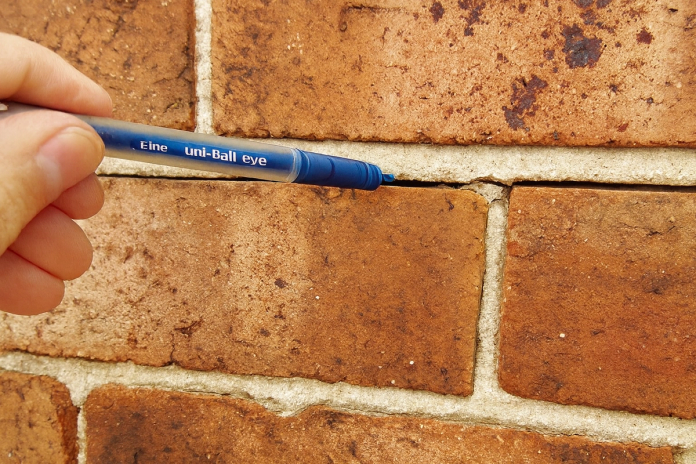
Wall tie failure is one of the few structural defects with a signature so distinctive that a surveyor can often name it from the pavement. It is also concealed, gradual, and common in a particular band of housing, which is a combination that makes it worth understanding before you buy rather than afterwards.
Cavity wall tie failure is the corrosion of the metal ties buried in the mortar of an older cavity wall. This guide covers the symptoms, which houses are most at risk, how a cavity wall tie inspection confirms it, and what replacement typically involves.
What are cavity wall ties?
A cavity wall is two separate leaves of masonry with a gap between them. The gap is what keeps driving rain from reaching the inside; the ties are what stop the two leaves behaving as two independent walls. Embedded in the mortar bed joints of both leaves, they hold the outer leaf against the inner one and let the pair act as a single structural element.
Cavity construction became normal in UK housing from the 1920s and near universal after the Second World War. Ties are set at roughly 900mm horizontal and 450mm vertical centres, closer at openings and at the corners, which is why the damage they cause when they fail appears at regular, predictable intervals.
What is cavity wall tie failure?
It is the corrosion of the tie inside the wall. Ties made of mild steel, whether galvanised lightly or not at all, rust where moisture reaches them. Rust occupies more space than the metal it replaces, so a corroding tie expands within the mortar bed it sits in and lifts the brickwork above it.
Two things follow, and they matter in different ways. The tie loses section and eventually loses its ability to restrain the outer leaf, which is the structural problem. And the expansion cracks and lifts the bed joints, which is the visible problem and the reason the defect is detectable at all. The second is what brings people to look for the first.
What causes cavity wall tie corrosion?
- Mild steel ties with thin or failed galvanising, which is the dominant cause in pre-1980s housing.
- Persistent moisture in the cavity from driving rain, defective pointing, blocked cavity trays or bridged cavities.
- Exposure: coastal salt, hilltop and west-facing elevations take the worst of the weather and fail first.
- Black ash mortar in some older construction, which is aggressive to steel.
- Poor original installation, including too few ties or ties sloping inwards so they carry water across the cavity.
Modern stainless steel ties are not subject to this. The problem belongs to a defined era of construction rather than to cavity walls in general.
Cavity wall tie failure symptoms: the signs
The signature is horizontal cracking along mortar bed joints at regular vertical intervals, typically every 450mm or so, which is about every six courses of brickwork. That regularity is the giveaway: no other common defect produces evenly spaced horizontal cracks up an elevation.
Alongside that, look for:
- Cracking concentrated on the most exposed elevation, often one gable or the weather face, while the sheltered sides look sound.
- Bulging or bowing of the outer leaf, visible by sighting along the wall rather than facing it.
- Vertical cracking at corners, where the two elevations are pulling apart.
- Lifting of the outer leaf relative to window and door frames, or a roofline that has been pushed up locally.
- Stepped cracking is generally NOT this defect. That pattern points to foundation movement instead.
What are the signs of wall tie failure inside?
Usually none, and that is worth stating plainly, because it is why the defect goes unnoticed. The inner leaf is not the one being lifted, so internal decoration frequently shows nothing at all while the outer leaf is well advanced. Damp penetration can appear where cracking has let water in, but it is a secondary effect and easily attributed to something else.
Which houses are most at risk?
Cavity-walled properties built between the 1920s and the late 1970s, with the highest risk in the earlier part of that range and in exposed or coastal locations. Houses built from the 1980s onwards generally have ties with far better corrosion protection, and post-1981 construction moved decisively towards stainless steel.
Age alone does not condemn a house. Plenty of 1930s properties have ties in serviceable condition because their walls have stayed dry and their pointing has been maintained. Exposure and maintenance history are what separate the ones that have failed from the ones that have not.
How a cavity wall tie survey and inspection confirms it
Visible cracking is a strong indicator but not proof, so confirmation is a separate step from a survey. A cavity wall tie specialist locates the ties with a metal detector, then makes a small opening or uses a borescope through a drilled hole to see the tie itself and assess how much section it has lost. Sampling across elevations establishes whether the problem is general or confined to the weather face.
This cavity wall tie inspection is intrusive, which is why it is a recommendation rather than something included in a pre-purchase survey. What the survey does is establish whether the investigation is warranted, which is the decision you need before exchange.
How are cavity wall ties replaced?
Cavity wall tie replacement means installing remedial ties through the outer leaf into the inner one, mechanically fixed or resin bonded, at a density set by an engineer or the system designer. The failed ties are isolated or removed where they are causing continuing expansion. The work is done from outside, does not require the wall to be rebuilt, and does not usually mean moving out.
Where the outer leaf has bowed significantly, or where cracking is severe, partial rebuilding of that leaf may be needed as well. Cost is driven by the area of elevation treated, the tie density specified, and access, which is why it varies so widely between a single gable and a whole house in scaffolding. It is a substantially smaller intervention than underpinning, and a well-executed cavity wall tie repair is a permanent repair rather than a holding measure.
Should you buy a house with cavity wall tie failure?
Often yes, on the right terms, because unlike some structural defects this one has a defined remedy with a predictable outcome. The questions that decide it are practical:
- Has the extent been established by investigation, or only inferred from cracking?
- Is it confined to one exposed elevation or present throughout?
- Has the outer leaf bowed, which adds rebuilding to the scope?
- If cavity wall ties repairs have already been done, is there a specification, a guarantee and evidence of who designed it?
- Does the quotation cover making good the cracking and repointing, or only the ties?
A diagnosed, quoted defect is a negotiating position. An undiagnosed one is an open question, and the sensible order is to find out before exchange rather than after.
How a survey identifies cavity wall tie failure
A surveyor examines each elevation for the regular horizontal cracking pattern, sights along the walls to detect bowing that is invisible face-on, checks the corners and the junctions with openings, and relates what is visible to the age and construction of the building and its exposure. Where the pattern is present, the recommendation is investigation by a specialist rather than a conclusion drawn from the outside.
A Level 2 Homebuyers Survey will record and rate the cracking and say what should happen next. A Level 3 Building Survey sets out the likely cause and extent, what follows if it is left, and what the remedial options are, which is the report to commission where the pattern is already visible.
If you are not sure which level suits the property, the tool below gives a straight recommendation from a few questions.
Regular horizontal cracking is characteristic of wall ties, but not every crack is. Stepped diagonal cracking points instead to subsidence, and fine cracking early in a building's life is usually settlement. Reading the pattern is what separates them. For a worked example, see our Level 3 survey of a period semi in Manchester, where cavity wall ties were among the findings.
Frequently asked questions
Is cavity wall tie failure dangerous?
It is progressive rather than sudden, and a house does not become unsafe overnight. Left long enough, the outer leaf loses its restraint and can bow and, in severe and neglected cases, become unstable, which is why advanced bowing is treated seriously. The realistic risk in a property being bought and sold is cost and negotiation rather than immediate danger.
How much does cavity wall tie failure cost to put right?
It varies too widely for a single figure to be useful, and it is driven by the area of wall treated, the tie density specified, whether scaffolding is required, and whether any rebuilding of the outer leaf is needed. Treating one exposed gable is a different job from treating a whole detached house. It is a considerably smaller intervention than underpinning, and any quotation should state whether making good and repointing are included.
Does buildings insurance cover wall tie failure?
Generally not. It is gradual deterioration of a building component, which policies treat as wear and maintenance rather than as damage from an insured event. That distinction is the same one that excludes most damp claims, and it is applied consistently.
Will cavity wall tie failure affect a mortgage?
It can. A valuer who sees the characteristic cracking may recommend a retention until a specialist report establishes the extent, or make the advance conditional on the work being done. Evidence that the problem has been investigated, quoted and specified is what usually resolves it, which is another reason to establish the extent before exchange.
How long do cavity wall ties last?
Modern stainless steel ties are expected to last the life of the building. Galvanised mild steel ties from the mid twentieth century have no fixed lifespan; their condition depends on how much moisture has reached them, so an exposed coastal wall can fail decades before a sheltered one in the same construction. Age indicates risk rather than determining it.
Can cavity wall ties be inspected without damaging the wall?
Partly. A metal detector locates them without any intervention, which establishes spacing and confirms ties are present. Assessing their condition needs a borescope through a small drilled hole, or a brick removed and reinstated. Both are minor and repairable, and neither is part of a standard pre-purchase survey, which is why it comes as a recommendation.
More on common defects
Settlement
What settlement is, how settlements differ from subsidence, and how to tell a cosmetic crack from one that needs investigating before you buy.
Read →Japanese Knotweed
What Japanese knotweed is, how to identify it, the plants it gets confused with, and your options for removal and remediation.
Read →Pest Infestations in Buildings: Causes, Signs and Prevention
What a pest infestation does to a building, how to spot one early, and the practical steps that keep rats, insects and birds out.
Read →Need a survey on a specific property?
Tell us the address and we will send a fixed price in writing, with no obligation.
Get your fixed quote →