
Subsidence
Recognising subsidence: the word every buyer dreads. What it actually is, how to tell it from settlement, and what happens next if a survey finds it.

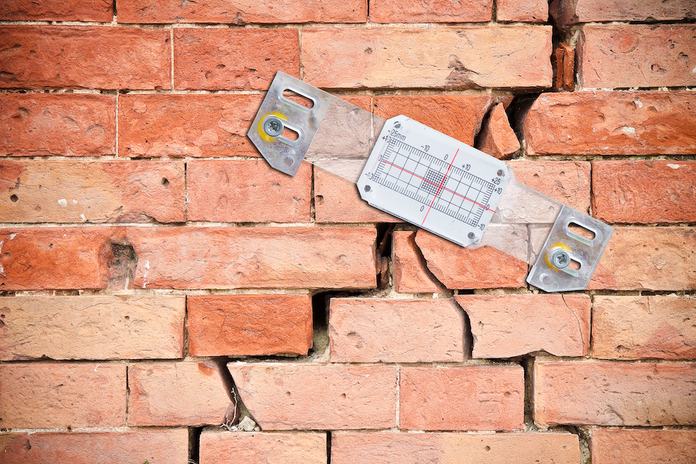
Subsidence is the defect buyers fear most and the one most often misdiagnosed. Most cracking in a house is not subsidence, and most subsidence does not need underpinning. This page sets out what it actually is, how to tell it apart from the movement every building does, and what happens next if a survey finds it.
What is subsidence?
Subsidence is the downward movement of the ground beneath a building's foundations, taking part of the structure down with it. The ground loses volume or support, the foundation follows, and because it rarely happens evenly the building is pulled out of shape. That distortion is what cracks the walls.
The word is used loosely for any crack in a house. Properly it means only this: the ground under the foundation has moved down. Where the ground has not moved, the cause is something else, and the something else is usually far less serious.
Subsidence meaning: the everyday word versus the technical one
In ordinary use, people say a wall or a floor has started to "subside" when they mean it has cracked or dropped. The subsidence meaning a surveyor works to is narrower. To subside is for the ground to move down and carry the foundation with it. If the ground has stayed put and the wall has still moved, that is not subsidence, whatever it looks like, and the repair is usually simpler and cheaper. Getting the meaning right is the first step in the diagnosis.
Subsidence, settlement and heave are not the same thing
Three different movements get called subsidence, and telling them apart is most of the diagnosis.
- Settlement is the ground compressing under the weight of a new building. It is normal, it happens in the first few years, and it usually stops. Fine cracking in a house under about ten years old is far more likely to be settlement than subsidence.
- Subsidence is the ground moving down for a reason unrelated to the building's weight: shrinking clay, a washed-out void, a leaking drain, an old mine working.
- Heave is the opposite, the ground swelling and lifting the foundation. It commonly follows the removal of a large tree, when clay that had been kept dry for decades slowly rehydrates.
Settlement is the one most often mistaken for subsidence, and the distinction changes everything about what happens next. There is a separate guide to settlement and how it differs.
What causes subsidence in the UK?
The causes are well understood and, in this country, dominated by one of them.
Clay shrinkage
The most common cause in the UK by a wide margin. Clay soils shrink as they dry and swell as they rewet, and a long dry summer can move the ground enough to take a foundation with it. Areas built on shrinkable clay see far more claims than areas on sand, gravel or rock, which is why subsidence maps of England follow the geology closely. There is more on this in our guide to soil types and their impact on foundation design.
Trees and large shrubs
A mature tree draws a great deal of water out of the ground in summer. Planted close to a house on clay it can dry the soil under the foundation and cause seasonal movement. The species matters as much as the distance: poplar, willow and oak are the usual culprits. Removing the tree is not automatically the answer, because on clay that can cause heave instead.
Leaking drains and water mains
A persistent leak washes fine material out of the ground and softens what is left, undermining the foundation locally. It is a common cause, it is often the cheapest to put right, and it is one of the first things to check because a drain survey is inexpensive next to the alternatives.
Made ground and poor preparation
Ground that was filled or levelled before building, and extensions added later without proper foundations, can both settle unevenly for years. Where an extension is moving and the original house is not, this is normally why.
Mining and historic ground workings
Across the North West, Yorkshire and the Midlands, old coal workings, brine extraction and quarrying leave ground that can still move. In cities such as Birmingham, where clay soils and a long industrial history sit side by side, subsidence tends to combine both: shrinkable ground and old workings under the same street. A coal mining search is the authoritative answer for any individual property, and where the workings are shallow the risk is a genuine one rather than a formality.
What are the signs of subsidence?
The signs below are what a surveyor looks for. Any one of them alone usually means little; it is the combination, and the pattern, that matters.
- Diagonal cracking, running at roughly 45 degrees and wider at the top than the bottom.
- Cracks concentrated around doors and windows, which are the weak points in a wall.
- Cracking visible on both the outside and the inside of the same wall.
- Doors and windows that begin to stick or no longer close squarely.
- Floors that slope noticeably, or gaps opening between the floor and the skirting.
- An extension or bay pulling away from the main building.
- Rippled or torn wallpaper over a crack, where the wall beneath has moved.
What matters more than any single sign is whether the movement is still happening. Cracks that have been filled and have reopened, or that widen and lengthen over months, point to active movement. Old cracks that have not changed in years are usually historic, and historic movement is a very different proposition to buy.
What do subsidence cracks look like?
Almost every house has some cracking. Width and pattern are what separate the trivial from the serious, and surveyors describe them using the categories in BRE Digest 251.
- Hairline cracking under about 0.1mm is negligible and needs nothing.
- Up to around 1mm is very slight, and normally filled during ordinary redecoration.
- Up to around 5mm is slight: worth recording and monitoring, easily filled.
- Between about 5mm and 15mm is moderate, and normally warrants investigation.
- Above about 15mm is severe, and needs a structural engineer rather than a surveyor.
Alongside width, a subsidence crack is typically diagonal rather than vertical or horizontal, tapers so that it is wider at one end, passes through the mortar and the bricks rather than following the joints alone, and appears in the same place inside and out. Vertical cracks at the join between a house and an extension are usually the two structures moving independently, which is common and rarely serious.
How is subsidence diagnosed?
A survey identifies the evidence and its likely cause. Confirming active subsidence, and its extent, is a separate specialist exercise that normally involves several of the following.
- Monitoring. Tell-tale gauges across the cracks, or precise level monitoring, read over a period. Twelve months is common, because it takes a full seasonal cycle to show whether clay-related movement is still happening.
- A drain survey, to establish whether a leak is undermining the ground.
- Trial pits, to expose the foundation and see what it is actually bearing on and how deep it goes.
- Soil analysis, to establish the shrinkage potential of the ground.
- A coal mining or brine search where the location warrants it.
This is why a survey that reports possible subsidence recommends further investigation rather than reaching a conclusion. Anyone who tells you a property definitely has active subsidence from a single visual inspection is guessing.
How do you fix subsidence?
The first step is always to remove the cause, and in the majority of cases that is the whole repair.
- Repairing a leaking drain, then allowing the ground to stabilise.
- Managing the trees: crown reduction and a maintenance regime rather than felling, since removing a mature tree from clay can cause heave.
- Improving drainage and surface water disposal away from the foundation.
- Then, once movement has stopped, repairing the superstructure: cutting out and rebuilding cracked brickwork, stitching with helical bars, repointing and redecorating.
Underpinning is the last resort, not the first. Most subsidence claims are settled without it, and a good engineer will exhaust the cheaper options first.
What is underpinning?
Underpinning means extending the foundation down to ground that can carry the load, normally by excavating beneath it in short sections and filling each with concrete before moving to the next. Piled and resin-injection systems do the same job by other means.
It is disruptive, it commonly runs into tens of thousands of pounds, and it carries a risk of its own: underpinning part of a building can leave the underpinned section stable while the rest continues to move, which produces new cracking at the junction. It is the right answer where movement is severe and progressive, and the wrong answer where a drain repair would have done.
For a buyer, an underpinned property is not automatically a bad buy. What matters is whether the work was designed by an engineer, properly documented, guaranteed, and whether the building has been stable since. A house underpinned twenty years ago with paperwork and no subsequent movement is often a safer purchase than an untouched house with fresh diagonal cracking.
Does home insurance cover subsidence?
Standard buildings insurance normally covers subsidence, heave and landslip, but with a specific and much higher excess than the rest of the policy. One thousand pounds is the common figure, and it applies to subsidence claims alone.
The practical difficulties are less about cover and more about disclosure and continuity. A history of subsidence must be declared, and failing to declare it can invalidate a policy. Premiums normally rise after a claim, and some insurers decline properties with a claims history altogether. Where an existing insurer will continue cover, a buyer can often take that policy on, which is frequently easier than arranging new cover, and it is worth asking the seller early. This is what people mean by subsidence insurance: not a separate product, but the terms attached to a property with a movement history.
Should you buy a house with subsidence?
Often, yes, provided you know what you are buying and pay accordingly. The questions that decide it are these.
- Is the movement historic or still active? Historic and stable is a very different risk.
- Is the cause known and has it been dealt with, or is it still there?
- Is there documentation: an engineer's report, a completion certificate, a guarantee?
- Will an insurer cover it, at what premium, and will the current policy transfer?
- Will a lender lend, and will they want a retention or a specialist report first?
Where the answers are good, subsidence in the past is a negotiating position rather than a reason to walk away. Where the movement is active and the cause unknown, it is a reason to find out more before exchanging, not after.
How a survey identifies subsidence
A surveyor examines the external and internal walls for the characteristic pattern, checks whether openings have distorted, assesses whether movement appears historic or ongoing, and looks at the contributing factors around the building: the trees, the drainage, the ground, the neighbouring properties and whether they show the same thing.
A Level 2 survey identifies the visible signs, rates the element accordingly, and recommends what should happen next.
A Level 3 survey goes further: it sets out the likely cause, whether the movement appears active, and what investigation or repair would be needed. That is the information that lets you decide whether to proceed, and on what terms.
Neither is a structural engineer's report, and neither should pretend to be. What a survey does is tell you whether that step is warranted, which is normally the decision you need before exchange.
Frequently asked questions
What is subsidence?
Subsidence is the downward movement of the ground beneath a building's foundations, which pulls part of the structure with it and cracks the walls. It is not the same as any crack in a house. The ground has to have moved down for the term to apply, and where it has not, the cause is usually something less serious such as settlement, thermal movement or a failing lintel. The subsidence meaning most people use in conversation is broader than the one a surveyor works to.
What is a subsidence claim?
A subsidence claim is a claim made on buildings insurance when ground movement has damaged a property. Standard policies normally cover subsidence, heave and landslip, but with a much higher excess than the rest of the policy, commonly one thousand pounds. The insurer will usually want the cause diagnosed and monitored before agreeing repairs, and any past claim must be declared when the property is sold or re-insured. This is the practical side of subsidence insurance: cover exists, but it comes with conditions.
How to fix subsidence?
The first and most important step is to remove the cause. Where a leaking drain is washing out the ground, the drain is repaired and the ground allowed to stabilise. Where a tree on clay is drawing out moisture, the tree is managed rather than felled, because felling can cause heave. Once the movement has stopped, the cracked brickwork is cut out and rebuilt or stitched, then repointed and redecorated. Underpinning is a last resort for severe, progressive movement, and most cases are resolved without it.
Is subsidence common?
It is far less common than the attention it gets suggests. Most cracking in most houses is not subsidence, and the great majority of properties never experience it. It concentrates where the ground invites it: shrinkable clay in the south and east, areas of historic mining, made ground, and buildings with mature trees close by. A crack is much more likely to be settlement, thermal movement or a failing lintel than subsidence, which is why diagnosis matters more than alarm.
How does subsidence affect a property's value?
Less than most sellers fear and more than most buyers hope. A property with historic, resolved and documented movement, insured without difficulty, often trades close to its unaffected value. Active movement with no diagnosis is a different matter, because the buyer is pricing an unknown and will discount accordingly, and a lender may retain funds until the question is answered. The variable that moves the price is not whether subsidence ever occurred but whether it has been diagnosed, dealt with and evidenced.
More on common defects
Cavity Wall Tie Failure
Cavity wall tie failure is concealed, gradual and common in a band of 1920s to 1970s housing. Here is how a surveyor spots it, how it is confirmed and what repair involves.
Read →Settlement
What settlement is, how settlements differ from subsidence, and how to tell a cosmetic crack from one that needs investigating before you buy.
Read →Japanese Knotweed
What Japanese knotweed is, how to identify it, the plants it gets confused with, and your options for removal and remediation.
Read →Need a survey on a specific property?
Tell us the address and we will send a fixed price in writing, with no obligation.
Get your fixed quote →