
Plants Mistaken for Japanese Knotweed
Several common garden plants look like Japanese knotweed but are harmless. Here is how to tell the difference, and when to get a specialist to be sure.

Why so many plants get mistaken for Japanese knotweed
Japanese knotweed has a bad reputation, and rightly so. It spreads fast, it is expensive to treat, and lenders take it seriously. That reputation means a lot of buyers now peer into a garden and see knotweed everywhere.
Most of the time, they are looking at something else. There are several plants mistaken for Japanese knotweed that share one or two features with it but are entirely harmless. A leaf shape, a hollow stem or a burst of summer growth is enough to set off alarm bells.
It helps to know what real knotweed looks like first. The classic signs are red-flecked, bamboo-like canes that grow in a zig-zag pattern, heart or shovel-shaped leaves arranged alternately up the stem, and creamy-white flower spikes in late summer. It dies back to brown, hollow canes over winter and shoots up again quickly in spring.
With that picture in mind, the lookalikes become easier to separate.
Chris Bloor, on siteA seller once met me at the door convinced there was knotweed down the side return. She had already had a sleepless week over it. We walked round and the plant was twining up the fence with white trumpet flowers, so it was bindweed, not knotweed. The giveaway was that it climbed. Knotweed stands on its own canes and does not cling to things. Ten minutes settled it. I told her to enjoy her weekend, and I meant it. Half the panics I see turn out to be something ordinary that got a bad look on a quiet afternoon.
The plants most often mistaken for knotweed
Bindweed
Hedge bindweed is probably the most common false alarm. It is a climbing plant with large white trumpet-shaped flowers and arrow or heart-shaped leaves.
The difference is the growth habit. Bindweed climbs and twines around anything it can reach: fences, drainpipes, other plants. Knotweed grows upright on its own stiff canes. Bindweed does not form the thick, self-supporting stems that knotweed does.
Bamboo
Bamboo and knotweed are often confused because both have hollow, jointed, cane-like stems. At a glance they can look very similar.
The leaves give it away. Bamboo has long, narrow, tapering leaves that look like grass blades. Knotweed leaves are broad and heart-shaped. Bamboo canes are also woody and stay standing through winter, whereas knotweed canes are more brittle and die back to brown hollow stems.
Bamboo can still be invasive and spread into neighbouring gardens, so it is not always welcome, but it is not knotweed and it does not carry the same lending problems.
Dogwood
Dogwood is a shrub often grown for its coloured winter stems, which can be red, orange or yellow. Those bright stems sometimes get mistaken for the red-flecked appearance of young knotweed.
Look at the leaves and the shape. Dogwood has oval leaves with clear curving veins, and it grows as a rounded shrub rather than shooting up in tall canes. The stems are solid and woody, not hollow.
Russian vine
Russian vine is a close relative of Japanese knotweed, which is why it causes so much confusion. It is sometimes called mile-a-minute for how fast it grows.
The key difference is that Russian vine is a climber. It scrambles over fences, sheds and hedges with masses of small creamy flowers. Knotweed stands upright on its own. If the plant is clinging to and climbing over a structure, it is far more likely to be Russian vine.
Lilac
Lilac is mistaken for knotweed mainly because of the leaf. Young lilac leaves are heart-shaped and can resemble knotweed foliage.
But lilac is a woody shrub or small tree with a solid trunk and branches. It does not produce hollow bamboo canes, and its famous scented purple or white flower clusters appear in spring, not the small white sprays of late-summer knotweed.
Houttuynia
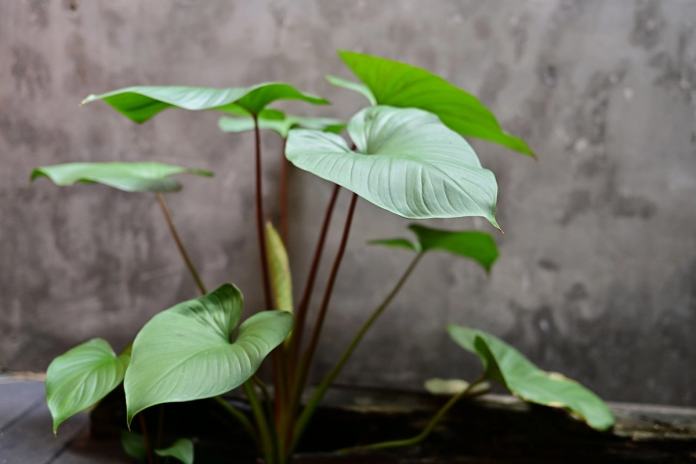
Houttuynia is a low-growing ground cover plant, sometimes grown for its variegated red, green and cream leaves. The heart-shaped leaves can catch a worried eye.
The scale settles it. Houttuynia stays low to the ground and spreads as a mat. It does not send up the tall canes that knotweed does. If the plant is ankle-height rather than knee to head-height, knotweed is unlikely.
A quick comparison
| Plant | Grows as | Leaf | Stem |
|---|---|---|---|
| Japanese knotweed | Tall upright canes | Heart-shaped, alternate | Hollow, red-flecked, zig-zag |
| Bindweed | Climbing, twining | Arrow-shaped | Thin, twining |
| Bamboo | Tall clumps | Narrow, grass-like | Woody, jointed |
| Russian vine | Climbing, scrambling | Heart-shaped | Trailing, woody |
| Lilac | Woody shrub | Heart-shaped | Solid, woody |
What to do if you are not sure
If a plant worries you, do not pull it up or cut it back before you know what it is. If it does turn out to be knotweed, disturbing it can make things worse and complicate treatment.
Instead, take clear photographs. Get the leaf shape, the way the leaves sit on the stem, the stem itself and the overall growth habit. Note the time of year, because the plant looks very different in spring, summer and winter. Those photos are what a specialist will need.
Chris Bloor, on siteWhen I find something I am not happy about, I photograph it from a few angles, then get in close on a single leaf and the stem where it meets the ground. I look along boundaries, behind sheds and against the neighbour's fence, because it often starts where nobody walks. In the report it goes down as a plant with the characteristics of knotweed, not a confirmed identification, with a recommendation to have a specialist confirm it. That wording matters. A lender wants a management plan from a contractor, and I am not the one to write that.
When a survey helps
If you are buying, a home survey is the sensible route. A RICS surveyor will note any plant that appears to be knotweed and flag it in the report, along with a recommendation on next steps. This is one of the things a survey is there to catch before you commit.
Our guide on do I need a survey when buying a house sets out what each level covers. If knotweed is confirmed, our page on Japanese knotweed explains what it means for the property and the mortgage.
When to get specialist identification
A surveyor's job is to identify a likely problem and advise you to investigate further, not to give a botanical certificate. If knotweed is suspected, we will usually recommend a specialist invasive weed contractor to confirm it and, if needed, quote for a treatment plan.
That is the point at which you get certainty. A specialist can identify the plant, confirm the extent of any growth, and produce a management plan that a lender will accept. If the survey raises other concerns as well, our guide on 10 red flags on a house survey is worth a read.
Frequently asked questions
How can I tell knotweed from bamboo?
Look at the leaves. Bamboo has long, narrow, grass-like leaves, while knotweed has broad heart-shaped leaves arranged in a zig-zag up the stem. Bamboo canes are woody and stay standing over winter; knotweed canes are more brittle and die back to hollow brown stems.
Does a home survey check for Japanese knotweed?
A RICS surveyor will note any plant that appears to be knotweed within the areas inspected and flag it in the report. The survey is not a specialist botanical inspection, so if knotweed is suspected we will recommend a specialist contractor to confirm it and advise on treatment.
Should I remove a plant I think might be knotweed?
No. If it does turn out to be knotweed, cutting or digging it can spread it and make treatment harder. Take clear photos of the leaf, stem and growth habit and get it identified before you disturb it.
Is Russian vine as much of a problem as knotweed?
Russian vine is a fast-growing climber and a relative of knotweed, but it does not carry the same lending and legal concerns. It can still be a nuisance because of how quickly it spreads, but it is treated as a garden management issue rather than a defect that affects the mortgage.
More on common defects
Dampness Survey Cost: What You Pay and What You Get
What a dampness survey typically costs, what drives the fee, what it should include, and when a damp investigation is worth commissioning.
Read →Wet Rot and Dry Rot: Signs and Treatment
Most rot found in houses is wet rot, and most wet rot is a localised, repairable problem. How to tell wet rot from dry rot, what dry rot treatment involves, and whether to buy.
Read →Pitched Roof Coverings
Common Defects on Pitched Roof Coverings Pitched roofs are a defining feature of UK homes, offering charm and robust protection against the elements.
Read →Need a survey on a specific property?
Tell us the address and we will send a fixed price in writing, with no obligation.
Get your fixed quote →