
Risks of Buying a House Without a Survey
Buying without a survey might seem like a way to save money, but it can leave you exposed to significant costs and problems you had no way of seeing coming.

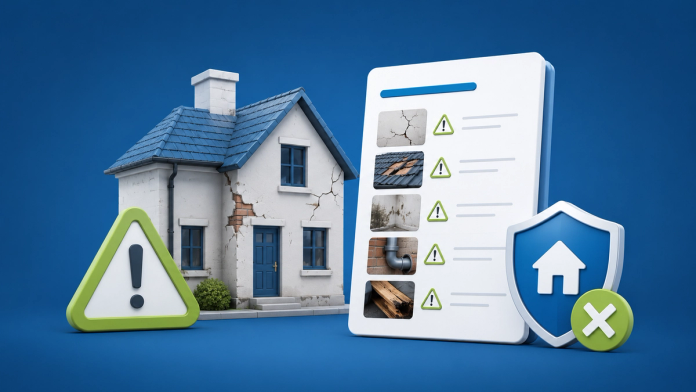
Every year, buyers complete property purchases without commissioning an independent survey. Some do it to save money, some because they feel the property looks fine, and some because they assume the mortgage valuation has already done the job. In most cases, they don’t find out what they’ve missed until after they’ve moved in — and by then, the cost of addressing it falls entirely on them.
A property survey is not a guarantee that nothing will go wrong. But it is the only way to get an independent, professional assessment of what you’re buying before you’re legally committed to buying it. Without one, you’re relying on what you can see on a viewing, which is rarely the full picture.
This post sets out the main risks of proceeding without a survey — what buyers typically miss, what it costs them, and why the price of a survey is almost always small relative to what it can uncover.
Wondering what defects might cost to fix?
Use our free Repair Cost Estimator to get a rough sense of what common property defects typically cost to address.
What a survey actually does
A RICS survey is a systematic inspection of a property carried out by a qualified surveyor on your behalf. It covers the building’s fabric — roof structure, walls, floors, windows, doors, drainage, and services — and assigns condition ratings to each element. Where problems are found, the surveyor provides professional commentary on their significance and, where appropriate, recommends further investigation.
The result is a written report that gives you documented evidence of the property’s condition at the point of purchase. That evidence can be used to inform your decision, support a price renegotiation, or — in serious cases — give you grounds to walk away before exchanging contracts.
Without a survey, none of that information exists. You’re making one of the largest financial commitments of your life based on what was visible during a viewing, typically lasting under an hour, with the seller or their agent present.
The principle of caveat emptor
In England and Wales, property purchases are governed by the principle of caveat emptor — buyer beware. This means the legal responsibility for identifying problems with a property rests with the buyer, not the seller. A seller is not required to disclose defects they haven’t been asked about, and in most cases has no obligation to volunteer information that might complicate the sale.
This is a critical point that many buyers don’t fully appreciate. Once you’ve exchanged contracts, you own the property and everything wrong with it. There is no general right of recourse against the seller for defects that were present but undisclosed, unless deliberate misrepresentation can be proved — which is difficult and expensive to establish.
A survey is your primary means of discharging that due diligence responsibility before you’re committed.
What buyers typically miss without a survey
The defects most commonly missed by buyers who proceed without a survey are not always the most obvious ones. Cosmetic presentation — fresh paint, new carpets, a recently tidied garden — can mask underlying problems that only a trained eye will identify.
Roof defects are among the most common and most expensive findings. Missing or slipped slates, deteriorated flashings, defective guttering, and inadequate ventilation in roof spaces are routine survey findings that are invisible from a viewing but can result in water ingress, timber decay, and significant remediation costs.
Damp and water ingress in various forms — rising damp, penetrating damp, condensation, and drainage failures — are consistently among the most frequent findings in RICS surveys. Many forms of damp are not visible to the untrained eye at the point of viewing, particularly in dry weather, and may not become apparent to a buyer until they’ve been living in the property through a winter.
Structural movement ranges from minor historic settlement, which may be of no ongoing significance, to active subsidence requiring urgent investigation and potentially underpinning. A surveyor can distinguish between the two. A buyer viewing a property cannot. The consequences of buying a property with unidentified active movement can be severe, affecting both the cost of remediation and the property’s future insurability and saleability.
Drainage problems — collapsed drains, root ingress, inadequate falls, and poorly connected systems — are another routine finding that requires specialist equipment to identify properly. Left unaddressed, drainage failures can cause significant damage to foundations and substructure.
Services and electrics may be outdated, non-compliant, or in poor condition in ways that aren’t apparent from a viewing. An aging consumer unit, outdated wiring, or a boiler beyond its serviceable life represent costs that buyers who skip a survey routinely discover only after they’ve moved in.
The Common Defects archive covers these and other frequent survey findings in more detail.
The financial risk of proceeding without a survey
The cost of a RICS survey is modest relative to the value of the transaction and the potential cost of the defects it might identify. Buyers who skip a survey to save on upfront costs routinely find themselves facing remediation bills that dwarf what a survey would have cost — and with no leverage to recover any of that cost from the seller.
More significantly, a survey finding gives you negotiating power before you’re committed. A documented defect identified pre-exchange gives you the ability to request a price reduction, ask the seller to remedy the issue, or factor the remediation cost into your offer. Post-completion, that leverage disappears entirely.
For a rough sense of what common defects typically cost to address, the Repair Cost Estimator is a useful starting point.
When buyers think they don’t need a survey
Several common assumptions lead buyers to skip a survey — most of them are mistaken.
“The mortgage valuation said it was fine.” A mortgage valuation confirms the property is worth broadly what you’ve agreed to pay. It is not a condition assessment, it does not identify defects, and it is produced to protect the lender, not you. A satisfactory mortgage valuation tells you nothing meaningful about the building’s condition.
“It’s a new build — it won’t have problems.” New builds are not immune to defects. Build quality varies significantly between developers, and quality control issues on new build sites are well documented. A RICS Level 2 Home Survey is well suited to newer properties and provides the kind of independent assessment a developer’s own inspection cannot.
“It looks fine from the viewing.” A viewing is not a survey. A seller presenting a property for sale has an interest in it looking its best. Surface presentation — decoration, cleanliness, staging — tells you almost nothing about the condition of the elements that matter: the roof, structure, drainage, damp, and services.
“Surveys aren’t worth it on cheaper properties.” The risk calculus works the other way. A defect that costs a significant sum to remediate has the same financial impact regardless of the purchase price. On a lower-value property, that cost represents a larger proportion of what you paid.
What type of survey do you need?
For most conventional properties in reasonable condition, a RICS Level 2 Home Survey provides the right level of assessment. For older properties, larger homes, those of non-standard construction, or anywhere defects are suspected, a RICS Level 3 Building Survey provides the more detailed investigation. The RICS Home Survey Guide explains the differences in full, and the free Which Survey Do I Need? tool can help you decide which is right for your property.
What buyers miss without a survey
Roof Defects
Missing slates, failed flashings, defective guttering, and poor ventilation are routine findings — and among the most expensive to remediate. Invisible from a viewing but clearly identifiable in a survey.
Damp & Water Ingress
Rising damp, penetrating damp, and drainage failures are consistently among the most frequent survey findings. Many forms are not visible at a viewing, particularly in dry weather.
Structural Movement
Ranges from minor historic settlement to active subsidence. A surveyor can distinguish between the two — a buyer viewing a property cannot. The consequences of missing active movement can be severe.
Drainage Problems
Collapsed drains, root ingress, and poorly connected systems require specialist equipment to identify. Left unaddressed, drainage failures can cause significant damage to foundations.
Services & Electrics
Outdated wiring, ageing consumer units, and boilers beyond their serviceable life are costs buyers without surveys routinely discover only after moving in — with no leverage to recover them.
Caveat Emptor
Buyer beware. In England and Wales, the legal responsibility for identifying defects rests with the buyer. Post-exchange, there is no general right of recourse against the seller for undisclosed defects.
What to do before you commit
The right time to commission a survey is after your offer has been accepted and before you exchange contracts. That window is when your leverage is greatest — you have enough commitment in the transaction to justify the cost of a survey, but you haven’t yet reached the point where walking away or renegotiating becomes significantly more complicated.
If a survey does identify defects, you have several options. You can request a price reduction to reflect the cost of remediation, ask the seller to address specific issues before exchange, factor the cost into your own planning and proceed at the existing price, or — in cases where the findings are serious enough — withdraw from the purchase before you’re legally committed.
None of those options are available to you after exchange. That is the moment a survey stops being useful and the cost of every defect becomes yours alone.
For most conventional properties, a Level 2 Home Survey is the appropriate starting point. For older, larger, or non-standard properties, a Level 3 Building Survey provides the more detailed investigation. If you’re unsure which is right for your property, the free Which Survey Do I Need? tool will point you in the right direction.
Is a survey a legal requirement when buying a property?
No — a survey is not a legal requirement in England and Wales. However, the principle of caveat emptor (buyer beware) means the legal responsibility for identifying defects rests with the buyer. A survey is the primary means of discharging that responsibility before you’re committed to the purchase.
Can I rely on the mortgage valuation instead of getting a survey?
No. A mortgage valuation confirms the property is worth broadly what you’ve agreed to pay — it is produced to protect the lender, not you. It does not assess the condition of the building, identify defects, or give you any professional recourse. A survey and a mortgage valuation serve entirely different purposes.
What if the property looks fine from the viewing?
A viewing is not a survey. Surface presentation — fresh decoration, new carpets, a tidy garden — can mask significant underlying problems. The defects most likely to cost you money are typically not visible to the untrained eye: roof structure, damp, drainage, structural movement, and the condition of services.
Are surveys worth it on cheaper properties?
Yes. The cost of remediating a serious defect is largely independent of the property’s purchase price. On a lower-value property, a significant repair bill represents a larger proportion of what you paid — making the case for a survey stronger, not weaker.
What happens if a survey finds problems?
If a survey identifies defects before exchange, you have options: request a price reduction, ask the seller to remedy the issue, factor the cost into your planning, or withdraw from the purchase. Post-exchange, those options are no longer available — the cost of every defect becomes yours.
Which survey do I need?
For most conventional properties in reasonable condition, a Level 2 Home Survey is the right starting point. For older, larger, or non-standard properties — or anywhere defects are suspected — a Level 3 Building Survey provides the more detailed investigation. Our free Which Survey Do I Need? tool can help you decide.
Get a survey before you commit
A RICS survey gives you independent, professional evidence of what you're buying — before you're legally committed to buying it. Get a quote for a Level 2 or Level 3 survey and go into your purchase with your eyes open.
More on rics home surveys
Survey vs Mortgage Valuation — What’s the Difference?
A mortgage valuation and a property survey are not the same thing. Here’s what each covers, who it protects, and what buyers need to know before committing.
Read →New Build Snagging Survey: What It Is and What to Do Instead Before You Buy
A new build snagging survey checks a newly completed home for defects before or after you move in. Here’s what it covers, what it typically finds, and what independent survey option makes more sense if you’re buying.
Read →RICS Condition Ratings Explained
Your RICS survey report gives every element a Condition Rating of 1, 2, 3 or NI. Here’s what each one means and what to do when you see it.
Read →Need a survey on a specific property?
Tell us the address and we will send a fixed price in writing, with no obligation.
Get your fixed quote →